The MIPCOM TV trade fair has kicked off in Cannes. Early news from the kids section is that short-formats are back in style, with a preference for live action. Established characters are being sought out (which is not such good news for people that want to try and create new ones). As scriptwriters it is important to keep an eye on these things, as I don't see the point in working for 18 months on a dead format.
Check for details on Cannes or Bust.
Showing posts with label TV. Show all posts
Showing posts with label TV. Show all posts
Monday, October 05, 2009


Thursday, May 28, 2009
Stephen Fry: UK TV writers "treated like dirt"
Celebrated British actor and writer Stephen Fry has spoken out against the British TV production system, claiming the writers are "treated like dirt". He particularly points to the fact that writers are generally dispossessed of their work when production starts. In a report in The Stage, he is quoted as saying, “Occasionally, if there’s a good relationship, a writer can come and visit the set, but their job - if they know anything about the etiquette of a set - is to sit very quietly in a corner and is certainly not to talk to an actor about anything but gossip and it is certainly not to talk about the part [they have written], because that undermines the relationship of the actor and director,” he said.
In addition to his high-profile acting, Fry has written for TV and is the writer of "Bright Young Things". For the full story, visit The Stage.
In addition to his high-profile acting, Fry has written for TV and is the writer of "Bright Young Things". For the full story, visit The Stage.
Wednesday, April 01, 2009
New Adjani film debuts on TV

Purely by accident, I caught most of the new Isabelle Adjani film "La journée de la jupe" written and directed by Jean-Paul Lilienfeld on Arte recently. I was impressed by the young cast and wondered why I hadn't heard about it before. The reason is that the film actually premièred on television, and is only now being released in France and Belgium. Isn't this backwards logic? Aren't we told that movies should be in the theatres first and then on TV and lastly on DVD? It's all the more interesting as the film brought Arte its biggest audience rating to date, nearly 2.5 million spectators or almost 9.6% of French TV audiences.
It will be interesting to see if this creates a buzz for the release. It certainly worked for Arte. The film has caused such debate that Arte decided to postpone the re-broadcasts. A message on Isabelle Adjani's blog invites people to catch the movie in theatres. Arte is a co-producer with Mascaret Films, Fontana and the RTBF. Visit the official site (in French).
Wednesday, August 13, 2008
"Doctor Who" scripts picks up Hugo award
"Blink", an episode of the rejuvenated BBC series "Doctor Who", received a Hugo Award on August 9 last, in the section for Best Dramatic Presentation Short Form (in this case a TV episode). The Hugo Awards are awards for excellence in the field of science fiction and fantasy. They were first awarded in 1953, and then every year since 1955. The awards are run by and voted on by fans and are billed as the "biggest award in fandom". They are awarded each year at the World Science Fiction Convention (Worldcon).
"Blink" was written by Steven Moffat and directed by Hettie MacDonald. Moffat has written extensively for TV, including "Coupling", "Doctor Who" and "Jekyll". Moffat won this category for the past two years - with "The Empty Child/The Doctor Dances" and "The Girl in the Fireplace". He is currently working on an adaptation of the Belgian comic strip hero "Tintin".
"Blink" is in the third series of "Doctor Who".
"Blink" was written by Steven Moffat and directed by Hettie MacDonald. Moffat has written extensively for TV, including "Coupling", "Doctor Who" and "Jekyll". Moffat won this category for the past two years - with "The Empty Child/The Doctor Dances" and "The Girl in the Fireplace". He is currently working on an adaptation of the Belgian comic strip hero "Tintin".
"Blink" is in the third series of "Doctor Who".
Friday, November 02, 2007
Song lyrics for Belgian hit movie "Vermist"

This summer, I got a call from composer Steve Willaert who was writing music for the Belgian thriller “Vermist/Missing” directed by Jan Verheyen. He was preparing a track for the end of the film and could I help with the lyrics? After a little coming and going, the result was “Waiting” breathlessly sung by Chantal Kashala. What I didn’t know at the time is that the film stars two of Flanders’ biggest new actors, Koen De Bouw and Kevin Janssens. So when I went to see it on the second night, I was surprised to find a capacity audience in one of the largest theatres (it opened in 29 cinemas in Flanders). “Waiting” plays over the final credits. I’ve had music used in movies before, but this is the first time I’ve written something from scratch for one. There are plans to turn “Vermist” into a TV series. Check Vermist here. Scriptwriters are Bas Adriaensen, Philippe De Schepper and Matt Witten.
Download the track from A-Lyric.
Wednesday, October 17, 2007
French TV writers come together

Anyone near the south of France that is interested in TV series (and the writing thereof!) should check out "Scénaristes en série", an annual get-together that was started by 10 French series writers and is becoming more international. The idea is for writers, producers, actors and distributors to get together in a series of debates and masterclasses. They promise to show the best-in-class series from Spain, the UK, Germany and Canada.
It will be held at the Palais des Congrès in Aix-les-Bains (Rhône-Alpes, if my memory serves me well), October 18-21. Contact: Tel : 01 48 03 18 25 (in France) or visit Scenaristes en Série. There are several regional airports in the area, plus a special TGV train leaving from Paris! How's that for style?
Tuesday, February 20, 2007
Irish film and TV awards
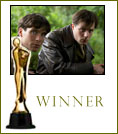
The Irish Film & TV Awards were held on February 9, with awards going to what was clearly a very good year for Irish film generally. The two heavyweights this year were Ken Loach's "The Wind That Shakes the Barley" (photo), which picked up the Best Film award, and "Breakfast on Pluto" that picked up the Best Script award for Neil Jordan and Pat McCabe. Cilliam Murphy also picked up a Best Actor award for his role in "Breakfast".
Also worth checking is "Small Engine Repair", written by Niall Heery. For the full list of winners, check the Irish Film & TV Awards.
Monday, February 05, 2007
UK: How to write a TV treatment
It's a well-known fact that TV offers more work for writers than anywhere else. And just like in movies, the producers are sighing, "Where are all the good writers?" To hopefully help you provide the answer, London's The Script Factory is running a special event aimed at getting you on the first rung of the ladder on March 29 & 30, 2007. "How to Write a TV Treatment" will be led by Yvonne Grace (who has worked in various writing and production roles for "Coronation Street", "Eastenders" and "Crossroads"), and there are only 12 places available. For details, visit The Script Factory.
Sunday, August 20, 2006
British sitcoms celebrated in documentary
Britain has been producing sitcoms since the fifties, so it was about time the subject was given a serious documentary. "Laughter in the House" is a superb look at the history and peak moments of British sitcoms, from the earliest days up to the recent classics such as "Only Fools and Horses" (written by John Sullivan), "The Young Ones", Fawlty Towers", "Blackadder" and "Rising Damp". Of particular interest to writers are the numerous interviews of the scriptwriters, many of whom wore woolie jumpers. Argh, what does that tell us about the writing profession?
The series is currently running on BBC2. If this link doesn't help, try the BBC2 homepage.
"Only Fools and Horses" has just been voted by viewers as Britain's best Sitcom, edging out "Blackadder", "Vicar of Dibly", "Dad's Army" and "Fawlty Towes". But where does "Absolutely Fabulous" come in? For the full list, click here.
The series is currently running on BBC2. If this link doesn't help, try the BBC2 homepage.
"Only Fools and Horses" has just been voted by viewers as Britain's best Sitcom, edging out "Blackadder", "Vicar of Dibly", "Dad's Army" and "Fawlty Towes". But where does "Absolutely Fabulous" come in? For the full list, click here.
Thursday, December 15, 2005
Europe's "Television Without Frontiers": development hell?
 The EU’s Television Without Frontiers Directive is not the stuff of novels. Yet its implications for movies, television – and therefore writers – is considerable. Pyrrhus Mercouris of the FSE (Federation of Scriptwriters in Europe) gave a quick overview of the ongoing review of the Directive to members of Belgium’s Association des Scénaristes de l’Audiovisuel recently.
The Directive’s goal is to harmonise legislation governing the very diverse TV sector in Europe. With the EU’s complex web of private and public channels, languages, legislation and copyright issues, finding some sort of common ground was never easy. The original Directive was adopted in 1989, amended in 1997 with a new draft Directive soon to be announced.
One of the key elements of the existing Directive is its encouragement of the production of European audiovisual works. For TV channels, this meant the obligation to show 50% European content. Yet a review has shown that very few channels respect the quota. “And some people were surprised to find that weather forecasts were being counted as European productions,” notes Mercouris. A significant part of the problem is that Margaret Thatcher managed to add a proviso to the Directive that it would be applied, “where appropriate”.
Canada and more recently Australia opted for a deregulated approach to the audiovisual sector. Consequently, Australia only shows about 9% local production. The age of hits such as “Priscilla Queen of the Desert” is over.
Penetration
Some countries, such as Ireland and Belgium, are very heavily “penetrated” by other countries’ television. Ireland feels that it simply cannot compete with the massive budgets of the BBC, making it impossible for it to meet the quota of 50%. Other countries are looking to exert more control over incoming advertising and broadcasts that specifically target a country despite being located outside its jurisdiction.
Looking ahead, the FES would like the Directive to be extended to the web, given that telcos are already preparing for Internet and mobile phone broadcasts. DRM gives them the means of controlling the use of their files. Nothing, however, guarantees that the relevant creators will see any of this new revenue.
Harmonisation would provide a clearer framework. Currently, authors’ rights are paid differently in the EU, with Ireland’s independent sector singled out for its particularly bad treatment of scriptwriters. Across Europe, writers complain of the difficulty of getting payment for their work despite being at the basis of many of the works. This makes a good case for maintaining the payment of authors rights on broadcasts.
"No internal market"
Strangely, the debate on film and TV is lumped with the information technology sectors rather than culture at the EU level. This means the priorities are sometimes more economic than cultural, with issues being discussed in terms of the internal market. “There is no internal market in film and TV,” says Mercouris. “Research shows that Europeans like to watch locally produced material at prime time. But there is very little being shown from other European countries. On the other hand, US shows that cost $6 million to produce are being sold off for $100,000 in some countries.” Needless to say, local productions in smaller East European countries and Greece cannot compete.
Negotiations are ongoing.
The FSE was created in 2001, and represents 4,500 writers from 14 countries. Writer guilds from three further countries, Sweden, Finland and Turkey, are currently considering joining. To find out more about the Television Without Borders Directive, see the European Parliament site.
Subscribe to:
Posts (Atom)