Tuesday, October 07, 2008

"Love is All" picks up Best Dutch film award


The box-office hit comedy "Love is All/Alles is Liefde" picked up the Best Film award at the 2008 Golden Calves ceremony (Dutch national film awards) on the last day of the Netherlands Film Festival. Over a million visitors saw the film last year, which also earned the Best Director Golden Calf for Joram Lürsen. The script is by Kim van Kooten.

Robert Jan Westdijk’s "In Real Life" won awards in the categories of Best Cinematography and Best Editing, while Mijke de Jong’s "Katia’s Sister" was awarded Golden Calves for Best Supporting Actress (Olga Louzgina), and Best Screenplay, for Jan Eilander and Jolein Laarman. Paula van der Oest’s "Tiramisu" won Best Actress honours for Anneke Blok and Best Score for Michiel Borstlap.

The acting awards for men went to Robert de Hoog for his role as a Jewish skinhead in "Skin" and Ton Kas for his supporting role in the political satire "Vox Populi". The Audience Award went to "Mafrika" from Paul Ruven.

Local heroes
I often pick out winners at the festivals around Europe, and looking back at them, it still surprises me how few of them break through outside their home territories. Scandinavia has a thriving local cinema that simply does not travel for the moment. The region of Flanders in Belgium has the same problem. In fact, it's worse. Even though they share a language with the Netherlands (Dutch), the two show very little interest in each others' movies.

This is clearly a huge handicap to the development of Europe's industry. Going back a decade or so, the French cinema used to produce movies of a large scale that were released globally. They often called on Italian or Polish directors for ambitious projects. They have scaled back considerably since then, despite a healthy flow of successes such as "Amélie Poulain", "La vie en rose" or the "Taxi" franchise.

Every five years or so, someone tries to set up a larger European company with global ambitions. But they seem to hit a glass ceiling every so often. It has also regularly been said that the type of project being produced in Europe (such as "Love is All") are films with in-built limitations in terms of mass appeal.

Until something changes - in either the development or the distribution - most of these local heroes seem to be condemned to being just that.

This article is featured on the Carnival of Cinema.

Thursday, October 02, 2008

"Louise Michel" picks up screenwriting award at San Sebastian


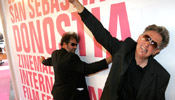
Gustave Kervern and Benoît Delépine (photo) have picked up the Best Screenplay award at Spain's 56th San Sebastian Film Festival for "Louise Michel". Their third feature, the film stars Yolande Moreau, Bouli Lanners, Benoît Poelevorde and Matthieu Kassovitz (who also co-produced) in a goofy tale of a hit-man and his client chasing an unscrupulous company boss. The film will screen at the London Film Festival (October 15-30) and open in Belgium on December 24. Overall winner at San Sebastian was the Turkish film "Pandora's Box" by Yesim Ustaoglu (co-written by Selma Kaygusuz), which also won Best Actress.

For details, check the 56th San Sebastian Film Festival.

Thursday, September 04, 2008

Italian films score at home, move to Toronto


Italian films made an impact at Venice this year, putting the country's cinema back on the map to a degree. Amongst the title that picked up the best reviews were Ferzan Ozpetek's Rome-set family drama "Perfect Day" (pictured right), the directorial debut of Marco Pontecorvo with "Pa-Ra-Da", the true story of the Franco-Algerian clown Miloud Oukili and Marco Bechis' "Birdwatchers". The first two are programmed for the upcoming Toronto festival.

In other Venice news, the challenging British movie "Hunger", about the IRA hunger striker Bobby Sands that died in prison, has picked up the Gucci Group award. "Hunger" was directed by Steve McQueen and written by McQueen and Enda Walsh ("Disco Pigs").

Wednesday, August 27, 2008

IRA flick in life rights issue


An interesting case for writers is about to hit the screen. "50 Dead Men Walking" is based on the autobiography of Martin McGartland, an RUC mole that infiltrated the IRA during Northern Ireland's "troubles" in the eighties. Yet McGartland recently claimed that his portrayal "misrepresents his life" as it shows him taking part in bombings and torture and is reserving his right to have the film withdrawn.

Of particular note is the fact that he told the magazine Screen International, "I definitely have a case in terms of infringement of my moral rights not only in the UK but all around the world. If my solicitor tells me it damages my reputation I will seek an injunction to see that the film is pulled and the DVD doesn’t seen the light of day."

The producers recently said of the film that "although inspired by the contents [of the book], it is not a representation of Mr McGartland's life". It is worth noting that they acquired the rights to the book and that McGartland was also given the option of having the main character's name changed, which he apparently declined. Not having read the agreement between him and the producers HandMade Films/Future Films, it is impossible to come to an opinion about this issue. But it does show the complexity of portraying real people on the screen, and the need to nail down any legal issues before production. By the same token, it shows the danger of undertaking a writing project without some sort of agreement with the subject of a biography and/or its authors.

"50 Dead Men Walking" was written and directed by Kari Skogland and will premiere at the Toronto International Film festival on September 10.

Sunday, August 17, 2008

Italian movies to dominate Venice Mostra

With 18 feature films being show, the Venice Film Festival will have a clear Italian tone to it this year. The 65th festival will be unlike any other, as it is going through a deep re-think of where it is in the festival circuit. The Rome festival is pulling some of the glamour later in the year, for example, which means producers and distributors often have to choose between the two. Venice also competes with Toronto and Cannes.

The Italian focus is also due to a lower number of American films, as the effects of less production due to the writers' strike are felt. Italian films in competition include Italian-Turkish director Ferzan Ozpetek's "Un Giorno Perfetto," featuring the events of one day on a group of people, and Pupi Avati with "Il Papa' di Giovanna," the story of a father dealing with his daughter's horrible crime.

Italian cinema has a low profile for the moment. This is not helped by political changes amongst the bodies that promote it - plus the fact that the news sites are no longer translated into English or French.

Interesting sites such as Cinecitta News are now monolingual. One of the most bizarre sites is Cinecitta's page about the festival, which details the architecture of the Spazio Italia it is hosting there but doesn't mention any films. This reflects the in-fighting going on inside the institutions at the expense of effective promotion.

If Venice sounds too exotic and far away for scriptwriters or directors, think again. I attended it a few years ago, flying low-cost and staying in a 'pensione' (very basic accommodation). For lunch, I chose to eat in working mens' canteens that were both tasty and cheap. At night, I ate in the self-service canteens at the festival. The only problem is finding tickets to the actual screenings. But there are plenty of opportunities to network anyway. Plus, Venice is truly one of the most magnificent towns on the planet.

Wednesday, August 13, 2008

"Doctor Who" scripts picks up Hugo award

"Blink", an episode of the rejuvenated BBC series "Doctor Who", received a Hugo Award on August 9 last, in the section for Best Dramatic Presentation Short Form (in this case a TV episode). The Hugo Awards are awards for excellence in the field of science fiction and fantasy. They were first awarded in 1953, and then every year since 1955. The awards are run by and voted on by fans and are billed as the "biggest award in fandom". They are awarded each year at the World Science Fiction Convention (Worldcon).

"Blink" was written by Steven Moffat and directed by Hettie MacDonald. Moffat has written extensively for TV, including "Coupling", "Doctor Who" and "Jekyll". Moffat won this category for the past two years - with "The Empty Child/The Doctor Dances" and "The Girl in the Fireplace". He is currently working on an adaptation of the Belgian comic strip hero "Tintin".

"Blink" is in the third series of "Doctor Who".

Tuesday, July 22, 2008

British films hit $3 billion mark in 2007

Although there are serious concerns about future productions, last year was a good year for British movies. According to figures released by the UK Film Council, British films raked in $3 billion last year, an increase of 50% over the previous year.

Film such as "Harry Potter and the Order of the Phoenix", "The Golden Compass" and "The Bourne Supremacy" helped British take 29% of the domestic box office, 16% in Europe and 12% in the US.

These successes are of course driven by the major (US) studios. The Council also points to the success of "Control" and "This is England" as examples of more specifically British film-making (although Anton Corbijn is in fact a Dutchman). Films to look forward to include new Bond and Potter movies as well as "Brideshead Revisited".

Tuesday, July 01, 2008

UK's Screenwriter Magazine becomes 12 Point.com


Screenwriter Magazine, perhaps the leading screenwriting magazine in Europe (with France's la Gazette des Scénaristes) is entering the digital age as TwelvePoint.com. From July 1, the magazine has become an online site and is (alas) no longer being printed. The new site will include the articles produced by Screenwriter, as well as all the bells and whistles you would expect of a website. This includes tips and an "ask the agent" section for subscribers as well as the inevitable forum.

If you move fast, you can pick up a free 10-day subscription. Check the site here.

Monday, June 23, 2008

Brussels festival celebrates first and second films

The sixth Brussels Film Festival is about to kick off, with its usual focus on first and second films from directors across Europe. The festival is opened and closed by "Melodrama Habibi/Une chanson dans la tête" by Hani Tamba and "Tricks" by Andrzej Jakimowski respectively (and a world and a Belgian premiere respectively too). Films to look out for include Germany's "The Stranger in Me", France's "57 000 km entre nous" and Russia's "Everybody Dies but Me".

The festival also features a special section devoted to rare movies, and an interesting selection of free outdoor screenings on the freshly-renovated Place Flagey in Ixelles. For film-makers there is a pitch competition (now closed) and a film workshop. Dates: June 28-July 6. For details in English, French and Dutch visit the Brussels Film Festival.

Sunday, June 08, 2008

RIP: Dino Risi, master of the Italian comedy


Dino Risi, master of the so-called "Italian comedy", died on Saturday June 7. Il maestro came to the spotlight with films such as "Il sorpresa/The Easy Life" and the original "Profuma di donna/Scent of a Woman", now better known as a remake starring Al Pacino.

I attended a special retrospective of his work in Brussels a few years back, and was struck by a number of things. All his films have the most amazingly brazen characters, which might also be due to the fact that he also worked with the most amazing actors such as Vittorio Gassman, Alberto Sordi and Ugo Tognazzi. His best films are also very clearly collaborative. You can feel the teamwork behind his minor masterpiece "I mostri/The Monsters", which would probably be more accurately translated as "Bastards". I asked at the time, "Who could possibly do movies like this these days?" The question still stands.

As a writer, I ask myself: which came first, the ferociously satirical scripts or the opportunity to create films with ferociously satirical actors?

Risi had some 50 films to his credit, and had a strong influence of post-war Italian cinema. He is the father of prolific director Marco Risi and received a Golden Lion at the Venice festival six years ago.

Salute, maestro.

Dino Risi on Amazon US
Dino Risi on Amazon UK

Jaco Van Dormael to talk in Brussels


One of the most promising writer/directors in Europe some ten years ago was Jaco Van Dormael, who made a huge splash with "Toto le héros" in 1991, followed by "Le huitième jour" in 1996. Rumours about his upcoming "Mr Nobody" have been extravagent to say the least, saying it covers "time" and is the most expensive Belgian film ever made.

This Tuesday June 10 he will put the rumours to rest or confirm them when he talks to the French-speaking Belgian writier's group ASA in Brussels.

For details, visit ASA.

Jaco Van Dormael on Amazon UK

Sunday, May 25, 2008

Dardennes Brothers pick up Cannes script award

I haven't much to say about the Dardennes Brothers' "Silence of Lorna", as I haven't seen it (I thought "La promesse" was a fascinating glimpse into a bleak lifestyle and noble sentiments).

So apart from congratulating the pair for their screenplay award at Cannes, all I can do is point you in the direction of the interview they gave Cineuropa some time back.

Check it here.

Friday, May 16, 2008

Out to lunches

Screenplay Europe will be going quiet for a few days, as I am packing for Cannes. I'm shopping two projects, "Protag" and "Tunerz", with a director and a producer respectively. The meetings have been lined up, the pitches honed (a good exercise in itself, of course - funny how you often get new insights into a story by constantly thinking up new pitches) and I'm feeling pretty upbeat about the whole exercise.

Plus, it will be nice to hang out with the film community for a few days. Anyone else down there can look out for me at the Belgian and Irish stands. I'll also be checking the conference schedule at the UK pavilion. Look for the dude with the hat.

Tuesday, May 13, 2008

European cinema on the rise in Europe

We're so used to bad news generally, that I suppose this counts as good news. According to figures released by Europe's Audiovisual Observatory, the share of European films in European cinemas last year was 28.8%, up by 0.2% This is against a background of slightly falling attendance of 1.3%.

The rise comes from a greater number of films produced in Europe, 921 against 911 last year. Increased production in France, Spain and Italy contributed significantly to overall growth. "With a total of 133 entirely national films (+6) and 52 majority co-productions (+15), France registered the second highest production level of the past five years, up 21 films from the previous year. Spanish production levels hit a record high, increasing 9% to 115 entirely national films (+6) and 30 majority co-productions (+6). Continuing its upward trend Italy counted a total of 109 ‘national’ films split into 93 national (+3) and 16 majority co-productions (+4). In contrast, production figures declined strongly in Hungary and Sweden, falling by -18 and -16 respectively. However in both cases this represents a return to more normal levels against a background of exceptional production activity in 2006," according o the Observatory.

It's interesting as the distribution situation in Spain and Italy is very difficult. So I just have to conclude that it's very difficult to stop film production!

The top 5 European films last year were: "Harry Potter", "la Môme", "Taxi 4", "Hot Fuzz" and "El Orfanato". Get the full press release on the Observatory site.

This article is quoted on Carnival of Cinema.

Thursday, May 08, 2008

Belgian distributor drops French-speaking Belgian films

If you read the blurbs for French-speaking Belgian movies over the past few years, everyone was upbeat: the films regularly pick up awards and the directors were celebrated in the world's press. Yet at home, the situation is entirely different. There have been numerous debates over the past few years about the disastrous box office results of French-speaking movies in Belgium. This has come to a head with the recent announcement that Lumière, until now the main distributor of the films, has decided to simply stop showing them.

Needless to say, this comes as quite a shock in a year that has three Belgian movies in competition in Cannes. However, the situation was perfectly foreseeable. For years, the focus has entirely been on so-called auteur movies to the expense of any others. Even the award-winning titles such as Bouli Lanner's "Ultranova" brought in very disappointing results. It should be pointed out that it's the distributors that take the greatest risk in these films. Production is partly subsidised by public funds, but not distribution. Although they are often hailed for their "personal" vision, the truth is that many of the films are personal to the point of being private indulgences.

Too much rope?
I remember a headline one year ago where a politician asked, "When will the Belgian audience be interested in Belgian movies?" It was, of course, the wrong question - as if the audience was there to serve the film-makers rather than the other way around. The Belgian audience will be interested in Belgian movies when the film-makers take an interest in the Belgian audience. That's the way it works in the real world. Many of these film-makers have simply been given too much rope for too long.

Just a short trip up the road, a different mentality can be seen. 2007 was one of the all-time best years for Belgium's Dutch-speaking film-makers, with numerous box-office hits and good results in art-house movies such as "Ben X". In fact, there is so much TV and film work that good scriptwriters are hard to find.

I know this might sound old-fashioned, but you must be doing something right when people are willing to pay to see your movies on a Saturday night. Deep down, I think too many people had gotten used to too much easy money for too long. I welcome the new constraints. They were a long time coming.

Sunday, April 27, 2008

French director wins "Crossing Europe" award for second time


French director and actress Isild Le Besco has won the European Competition for the second time and receives the CROSSING EUROPE Award European Competition 2008 for her film "Charly. The jury in Linz (Austria) called Le Besco an “original voice in European cinema” and added that “this simple ‘coming-of-age’ story lingered disturbingly in our minds due to its uncompromising style and great acting.”

Greek director Thanos Anastopoulos received a special mention for "Diorthosi/Correction". The Ray Audience Award went to "Ljubav i Drugi Zlocini/Love and Other Crimes" by Stefan Arsenijevic.

Wednesday, April 23, 2008

Pudor takes top prize at Lecce European Film festival


The Spanish film "Pudor" (Modesty) directed by David and Tristan Ulloa (on a script by the latter) walked away with the top prize at the European Film festival in Lecce, Italy. According to the jury, the film won the Golden Olive for “knowing how to command everyday surrealism with original solutions, applied to a subject that is today being discussed again and is in progressive transformation and dissolution – the family”.

The film bills itself as being "about intimacy... desires, obsessions, secrets and fears that we keep hidden, even from those we love most". The producer's site (in Spanish) can be seen here.

The best screenplay award went to Andrei Zvjagingev’s "The Banishment".

Tuesday, April 15, 2008

Gazette des Scénaristes: new issue


I have been writing here less as I have been writing more elsewhere. I'll be attending Cannes again with two projects in development: "Protag", a dark contemporary thriller for the YouTube generation, and "Tunerz", probably Europe's first movie about the tuning scene. So I'll be posting less as the deadline approaches and the pitches, treatments and cover letters are reworked.

The only news I have now is that the new issue of France's quarterly Gazette des Scénaristes is out. The Gazette is one of the best scriptwriter magazines. This issue looks at the future of scriptwriters (pretty bleak unless some heads are knocked together), has an open letter to "those who develop, finance and show films without scripts" (a blast at the ultra-auteur syndrome that is strangling European cinema) and a very big question: should we write like Americans?

I haven't read that article, but I already know what most people's answers will most likely be in Europe.

The Gazette can be bought by mail at Dixit.

Thursday, April 03, 2008

New French writer's site

For many years, Version Finale was the main hub of contact for France's writing community. It recently changed hands and many of the most active members moved to their own temporary board, called My-Scripts.net. As with many temporary things on the web, it might just end up being definitive.

Check the messageboard (le Forum). The members are toying with the idea of giving an award to the weirdest script (in French) at the Cannes festival, the Prix Zarbi.

Wednesday, March 26, 2008

Michael Haneke replays "Funny Games"


Austrian writer-director Michael Haneke (director of "Caché" and "The Piano Player") has pulled off an unusual stunt with the recent release of "Funny Games" in the US. The film is an almost shot-by-shot remake of the excellent though scary original Austrian language original, released in 1997. "Funny Games" is the tale of two clean-cut smiling sadists (Michael Pitt and Brady Corbet) that terrorise a family - for a while. It's rare, if not unique, for a remake to be a total remake, rather than an adaptation, given the differences in mainstream American audiences and the very varied European audiences.

The new version is picking up excellent reviews (some saying it's as good as the original). The official site: Funny Games US.

Funny Games 1997 on Amazon US