Sunday, October 12, 2008

Stranger than fiction: Italian actor arrested in mob swoop


Italy has decided to get heavy on the Mafia, sending 3,000 military in to the worst areas to support police activities. But in a bizarre twist, two actors who played the role of gangsters in the award-winning film "Gomorra" by Matteo Garrone have been arrested as part of a group of people associated with a Mafia gang in Naples. The arrests follow the murdering of six Africans suspected of dealing in drugs and who were killed as a way of warning others to back off the lucrative trade. Following rioting, thousands of people took to the streets to denounce the killings and organised crime, with a similar demonstration in Rome drawing a very large crowd.

The semi-professional actor Giovanni Venosa was known to the police as a petty criminal and was fingered by a prison inmate as a possible drugs pusher. He plays a local boss in the movie.

UK review on Time Out
Trailer in English on Optimum releasing.

Friday, October 10, 2008

William Friedkin masterclass in London

You might have to move fast on this one. William Friedkin is the writer/director/producer of landmark films such as "The French Connection" and "The Exorcist", both of which redefined their genres and provoked considerable outrage at the time. Since then, he has also produced "Cruising" and "To Live and Die in L.A." and is now active in TV and opera.

In an event organised by The Script Factory, he will be interviewed live by Mark Kermode following a screening of "The French Connection" on October 21 at 8pm at the Screen on the Green in Islington, London. Tickets priced £10 are on sale from Screen on The Green box office on 08700 664777.

Tuesday, October 07, 2008

"Love is All" picks up Best Dutch film award


The box-office hit comedy "Love is All/Alles is Liefde" picked up the Best Film award at the 2008 Golden Calves ceremony (Dutch national film awards) on the last day of the Netherlands Film Festival. Over a million visitors saw the film last year, which also earned the Best Director Golden Calf for Joram Lürsen. The script is by Kim van Kooten.

Robert Jan Westdijk’s "In Real Life" won awards in the categories of Best Cinematography and Best Editing, while Mijke de Jong’s "Katia’s Sister" was awarded Golden Calves for Best Supporting Actress (Olga Louzgina), and Best Screenplay, for Jan Eilander and Jolein Laarman. Paula van der Oest’s "Tiramisu" won Best Actress honours for Anneke Blok and Best Score for Michiel Borstlap.

The acting awards for men went to Robert de Hoog for his role as a Jewish skinhead in "Skin" and Ton Kas for his supporting role in the political satire "Vox Populi". The Audience Award went to "Mafrika" from Paul Ruven.

Local heroes
I often pick out winners at the festivals around Europe, and looking back at them, it still surprises me how few of them break through outside their home territories. Scandinavia has a thriving local cinema that simply does not travel for the moment. The region of Flanders in Belgium has the same problem. In fact, it's worse. Even though they share a language with the Netherlands (Dutch), the two show very little interest in each others' movies.

This is clearly a huge handicap to the development of Europe's industry. Going back a decade or so, the French cinema used to produce movies of a large scale that were released globally. They often called on Italian or Polish directors for ambitious projects. They have scaled back considerably since then, despite a healthy flow of successes such as "Amélie Poulain", "La vie en rose" or the "Taxi" franchise.

Every five years or so, someone tries to set up a larger European company with global ambitions. But they seem to hit a glass ceiling every so often. It has also regularly been said that the type of project being produced in Europe (such as "Love is All") are films with in-built limitations in terms of mass appeal.

Until something changes - in either the development or the distribution - most of these local heroes seem to be condemned to being just that.

This article is featured on the Carnival of Cinema.

Thursday, October 02, 2008

"Louise Michel" picks up screenwriting award at San Sebastian


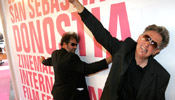
Gustave Kervern and Benoît Delépine (photo) have picked up the Best Screenplay award at Spain's 56th San Sebastian Film Festival for "Louise Michel". Their third feature, the film stars Yolande Moreau, Bouli Lanners, Benoît Poelevorde and Matthieu Kassovitz (who also co-produced) in a goofy tale of a hit-man and his client chasing an unscrupulous company boss. The film will screen at the London Film Festival (October 15-30) and open in Belgium on December 24. Overall winner at San Sebastian was the Turkish film "Pandora's Box" by Yesim Ustaoglu (co-written by Selma Kaygusuz), which also won Best Actress.

For details, check the 56th San Sebastian Film Festival.

Thursday, September 04, 2008

Italian films score at home, move to Toronto


Italian films made an impact at Venice this year, putting the country's cinema back on the map to a degree. Amongst the title that picked up the best reviews were Ferzan Ozpetek's Rome-set family drama "Perfect Day" (pictured right), the directorial debut of Marco Pontecorvo with "Pa-Ra-Da", the true story of the Franco-Algerian clown Miloud Oukili and Marco Bechis' "Birdwatchers". The first two are programmed for the upcoming Toronto festival.

In other Venice news, the challenging British movie "Hunger", about the IRA hunger striker Bobby Sands that died in prison, has picked up the Gucci Group award. "Hunger" was directed by Steve McQueen and written by McQueen and Enda Walsh ("Disco Pigs").

Wednesday, August 27, 2008

IRA flick in life rights issue


An interesting case for writers is about to hit the screen. "50 Dead Men Walking" is based on the autobiography of Martin McGartland, an RUC mole that infiltrated the IRA during Northern Ireland's "troubles" in the eighties. Yet McGartland recently claimed that his portrayal "misrepresents his life" as it shows him taking part in bombings and torture and is reserving his right to have the film withdrawn.

Of particular note is the fact that he told the magazine Screen International, "I definitely have a case in terms of infringement of my moral rights not only in the UK but all around the world. If my solicitor tells me it damages my reputation I will seek an injunction to see that the film is pulled and the DVD doesn’t seen the light of day."

The producers recently said of the film that "although inspired by the contents [of the book], it is not a representation of Mr McGartland's life". It is worth noting that they acquired the rights to the book and that McGartland was also given the option of having the main character's name changed, which he apparently declined. Not having read the agreement between him and the producers HandMade Films/Future Films, it is impossible to come to an opinion about this issue. But it does show the complexity of portraying real people on the screen, and the need to nail down any legal issues before production. By the same token, it shows the danger of undertaking a writing project without some sort of agreement with the subject of a biography and/or its authors.

"50 Dead Men Walking" was written and directed by Kari Skogland and will premiere at the Toronto International Film festival on September 10.

Sunday, August 17, 2008

Italian movies to dominate Venice Mostra

With 18 feature films being show, the Venice Film Festival will have a clear Italian tone to it this year. The 65th festival will be unlike any other, as it is going through a deep re-think of where it is in the festival circuit. The Rome festival is pulling some of the glamour later in the year, for example, which means producers and distributors often have to choose between the two. Venice also competes with Toronto and Cannes.

The Italian focus is also due to a lower number of American films, as the effects of less production due to the writers' strike are felt. Italian films in competition include Italian-Turkish director Ferzan Ozpetek's "Un Giorno Perfetto," featuring the events of one day on a group of people, and Pupi Avati with "Il Papa' di Giovanna," the story of a father dealing with his daughter's horrible crime.

Italian cinema has a low profile for the moment. This is not helped by political changes amongst the bodies that promote it - plus the fact that the news sites are no longer translated into English or French.

Interesting sites such as Cinecitta News are now monolingual. One of the most bizarre sites is Cinecitta's page about the festival, which details the architecture of the Spazio Italia it is hosting there but doesn't mention any films. This reflects the in-fighting going on inside the institutions at the expense of effective promotion.

If Venice sounds too exotic and far away for scriptwriters or directors, think again. I attended it a few years ago, flying low-cost and staying in a 'pensione' (very basic accommodation). For lunch, I chose to eat in working mens' canteens that were both tasty and cheap. At night, I ate in the self-service canteens at the festival. The only problem is finding tickets to the actual screenings. But there are plenty of opportunities to network anyway. Plus, Venice is truly one of the most magnificent towns on the planet.

Wednesday, August 13, 2008

"Doctor Who" scripts picks up Hugo award

"Blink", an episode of the rejuvenated BBC series "Doctor Who", received a Hugo Award on August 9 last, in the section for Best Dramatic Presentation Short Form (in this case a TV episode). The Hugo Awards are awards for excellence in the field of science fiction and fantasy. They were first awarded in 1953, and then every year since 1955. The awards are run by and voted on by fans and are billed as the "biggest award in fandom". They are awarded each year at the World Science Fiction Convention (Worldcon).

"Blink" was written by Steven Moffat and directed by Hettie MacDonald. Moffat has written extensively for TV, including "Coupling", "Doctor Who" and "Jekyll". Moffat won this category for the past two years - with "The Empty Child/The Doctor Dances" and "The Girl in the Fireplace". He is currently working on an adaptation of the Belgian comic strip hero "Tintin".

"Blink" is in the third series of "Doctor Who".

Tuesday, July 22, 2008

British films hit $3 billion mark in 2007

Although there are serious concerns about future productions, last year was a good year for British movies. According to figures released by the UK Film Council, British films raked in $3 billion last year, an increase of 50% over the previous year.

Film such as "Harry Potter and the Order of the Phoenix", "The Golden Compass" and "The Bourne Supremacy" helped British take 29% of the domestic box office, 16% in Europe and 12% in the US.

These successes are of course driven by the major (US) studios. The Council also points to the success of "Control" and "This is England" as examples of more specifically British film-making (although Anton Corbijn is in fact a Dutchman). Films to look forward to include new Bond and Potter movies as well as "Brideshead Revisited".

Tuesday, July 01, 2008

UK's Screenwriter Magazine becomes 12 Point.com


Screenwriter Magazine, perhaps the leading screenwriting magazine in Europe (with France's la Gazette des Scénaristes) is entering the digital age as TwelvePoint.com. From July 1, the magazine has become an online site and is (alas) no longer being printed. The new site will include the articles produced by Screenwriter, as well as all the bells and whistles you would expect of a website. This includes tips and an "ask the agent" section for subscribers as well as the inevitable forum.

If you move fast, you can pick up a free 10-day subscription. Check the site here.

Monday, June 23, 2008

Brussels festival celebrates first and second films

The sixth Brussels Film Festival is about to kick off, with its usual focus on first and second films from directors across Europe. The festival is opened and closed by "Melodrama Habibi/Une chanson dans la tête" by Hani Tamba and "Tricks" by Andrzej Jakimowski respectively (and a world and a Belgian premiere respectively too). Films to look out for include Germany's "The Stranger in Me", France's "57 000 km entre nous" and Russia's "Everybody Dies but Me".

The festival also features a special section devoted to rare movies, and an interesting selection of free outdoor screenings on the freshly-renovated Place Flagey in Ixelles. For film-makers there is a pitch competition (now closed) and a film workshop. Dates: June 28-July 6. For details in English, French and Dutch visit the Brussels Film Festival.

Sunday, June 08, 2008

RIP: Dino Risi, master of the Italian comedy


Dino Risi, master of the so-called "Italian comedy", died on Saturday June 7. Il maestro came to the spotlight with films such as "Il sorpresa/The Easy Life" and the original "Profuma di donna/Scent of a Woman", now better known as a remake starring Al Pacino.

I attended a special retrospective of his work in Brussels a few years back, and was struck by a number of things. All his films have the most amazingly brazen characters, which might also be due to the fact that he also worked with the most amazing actors such as Vittorio Gassman, Alberto Sordi and Ugo Tognazzi. His best films are also very clearly collaborative. You can feel the teamwork behind his minor masterpiece "I mostri/The Monsters", which would probably be more accurately translated as "Bastards". I asked at the time, "Who could possibly do movies like this these days?" The question still stands.

As a writer, I ask myself: which came first, the ferociously satirical scripts or the opportunity to create films with ferociously satirical actors?

Risi had some 50 films to his credit, and had a strong influence of post-war Italian cinema. He is the father of prolific director Marco Risi and received a Golden Lion at the Venice festival six years ago.

Salute, maestro.

Dino Risi on Amazon US
Dino Risi on Amazon UK

Jaco Van Dormael to talk in Brussels


One of the most promising writer/directors in Europe some ten years ago was Jaco Van Dormael, who made a huge splash with "Toto le héros" in 1991, followed by "Le huitième jour" in 1996. Rumours about his upcoming "Mr Nobody" have been extravagent to say the least, saying it covers "time" and is the most expensive Belgian film ever made.

This Tuesday June 10 he will put the rumours to rest or confirm them when he talks to the French-speaking Belgian writier's group ASA in Brussels.

For details, visit ASA.

Jaco Van Dormael on Amazon UK

Sunday, May 25, 2008

Dardennes Brothers pick up Cannes script award

I haven't much to say about the Dardennes Brothers' "Silence of Lorna", as I haven't seen it (I thought "La promesse" was a fascinating glimpse into a bleak lifestyle and noble sentiments).

So apart from congratulating the pair for their screenplay award at Cannes, all I can do is point you in the direction of the interview they gave Cineuropa some time back.

Check it here.

Friday, May 16, 2008

Out to lunches

Screenplay Europe will be going quiet for a few days, as I am packing for Cannes. I'm shopping two projects, "Protag" and "Tunerz", with a director and a producer respectively. The meetings have been lined up, the pitches honed (a good exercise in itself, of course - funny how you often get new insights into a story by constantly thinking up new pitches) and I'm feeling pretty upbeat about the whole exercise.

Plus, it will be nice to hang out with the film community for a few days. Anyone else down there can look out for me at the Belgian and Irish stands. I'll also be checking the conference schedule at the UK pavilion. Look for the dude with the hat.

Tuesday, May 13, 2008

European cinema on the rise in Europe

We're so used to bad news generally, that I suppose this counts as good news. According to figures released by Europe's Audiovisual Observatory, the share of European films in European cinemas last year was 28.8%, up by 0.2% This is against a background of slightly falling attendance of 1.3%.

The rise comes from a greater number of films produced in Europe, 921 against 911 last year. Increased production in France, Spain and Italy contributed significantly to overall growth. "With a total of 133 entirely national films (+6) and 52 majority co-productions (+15), France registered the second highest production level of the past five years, up 21 films from the previous year. Spanish production levels hit a record high, increasing 9% to 115 entirely national films (+6) and 30 majority co-productions (+6). Continuing its upward trend Italy counted a total of 109 ‘national’ films split into 93 national (+3) and 16 majority co-productions (+4). In contrast, production figures declined strongly in Hungary and Sweden, falling by -18 and -16 respectively. However in both cases this represents a return to more normal levels against a background of exceptional production activity in 2006," according o the Observatory.

It's interesting as the distribution situation in Spain and Italy is very difficult. So I just have to conclude that it's very difficult to stop film production!

The top 5 European films last year were: "Harry Potter", "la Môme", "Taxi 4", "Hot Fuzz" and "El Orfanato". Get the full press release on the Observatory site.

This article is quoted on Carnival of Cinema.

Thursday, May 08, 2008

Belgian distributor drops French-speaking Belgian films

If you read the blurbs for French-speaking Belgian movies over the past few years, everyone was upbeat: the films regularly pick up awards and the directors were celebrated in the world's press. Yet at home, the situation is entirely different. There have been numerous debates over the past few years about the disastrous box office results of French-speaking movies in Belgium. This has come to a head with the recent announcement that Lumière, until now the main distributor of the films, has decided to simply stop showing them.

Needless to say, this comes as quite a shock in a year that has three Belgian movies in competition in Cannes. However, the situation was perfectly foreseeable. For years, the focus has entirely been on so-called auteur movies to the expense of any others. Even the award-winning titles such as Bouli Lanner's "Ultranova" brought in very disappointing results. It should be pointed out that it's the distributors that take the greatest risk in these films. Production is partly subsidised by public funds, but not distribution. Although they are often hailed for their "personal" vision, the truth is that many of the films are personal to the point of being private indulgences.

Too much rope?
I remember a headline one year ago where a politician asked, "When will the Belgian audience be interested in Belgian movies?" It was, of course, the wrong question - as if the audience was there to serve the film-makers rather than the other way around. The Belgian audience will be interested in Belgian movies when the film-makers take an interest in the Belgian audience. That's the way it works in the real world. Many of these film-makers have simply been given too much rope for too long.

Just a short trip up the road, a different mentality can be seen. 2007 was one of the all-time best years for Belgium's Dutch-speaking film-makers, with numerous box-office hits and good results in art-house movies such as "Ben X". In fact, there is so much TV and film work that good scriptwriters are hard to find.

I know this might sound old-fashioned, but you must be doing something right when people are willing to pay to see your movies on a Saturday night. Deep down, I think too many people had gotten used to too much easy money for too long. I welcome the new constraints. They were a long time coming.

Sunday, April 27, 2008

French director wins "Crossing Europe" award for second time


French director and actress Isild Le Besco has won the European Competition for the second time and receives the CROSSING EUROPE Award European Competition 2008 for her film "Charly. The jury in Linz (Austria) called Le Besco an “original voice in European cinema” and added that “this simple ‘coming-of-age’ story lingered disturbingly in our minds due to its uncompromising style and great acting.”

Greek director Thanos Anastopoulos received a special mention for "Diorthosi/Correction". The Ray Audience Award went to "Ljubav i Drugi Zlocini/Love and Other Crimes" by Stefan Arsenijevic.

Wednesday, April 23, 2008

Pudor takes top prize at Lecce European Film festival


The Spanish film "Pudor" (Modesty) directed by David and Tristan Ulloa (on a script by the latter) walked away with the top prize at the European Film festival in Lecce, Italy. According to the jury, the film won the Golden Olive for “knowing how to command everyday surrealism with original solutions, applied to a subject that is today being discussed again and is in progressive transformation and dissolution – the family”.

The film bills itself as being "about intimacy... desires, obsessions, secrets and fears that we keep hidden, even from those we love most". The producer's site (in Spanish) can be seen here.

The best screenplay award went to Andrei Zvjagingev’s "The Banishment".

Tuesday, April 15, 2008

Gazette des Scénaristes: new issue


I have been writing here less as I have been writing more elsewhere. I'll be attending Cannes again with two projects in development: "Protag", a dark contemporary thriller for the YouTube generation, and "Tunerz", probably Europe's first movie about the tuning scene. So I'll be posting less as the deadline approaches and the pitches, treatments and cover letters are reworked.

The only news I have now is that the new issue of France's quarterly Gazette des Scénaristes is out. The Gazette is one of the best scriptwriter magazines. This issue looks at the future of scriptwriters (pretty bleak unless some heads are knocked together), has an open letter to "those who develop, finance and show films without scripts" (a blast at the ultra-auteur syndrome that is strangling European cinema) and a very big question: should we write like Americans?

I haven't read that article, but I already know what most people's answers will most likely be in Europe.

The Gazette can be bought by mail at Dixit.

Thursday, April 03, 2008

New French writer's site

For many years, Version Finale was the main hub of contact for France's writing community. It recently changed hands and many of the most active members moved to their own temporary board, called My-Scripts.net. As with many temporary things on the web, it might just end up being definitive.

Check the messageboard (le Forum). The members are toying with the idea of giving an award to the weirdest script (in French) at the Cannes festival, the Prix Zarbi.

Wednesday, March 26, 2008

Michael Haneke replays "Funny Games"


Austrian writer-director Michael Haneke (director of "Caché" and "The Piano Player") has pulled off an unusual stunt with the recent release of "Funny Games" in the US. The film is an almost shot-by-shot remake of the excellent though scary original Austrian language original, released in 1997. "Funny Games" is the tale of two clean-cut smiling sadists (Michael Pitt and Brady Corbet) that terrorise a family - for a while. It's rare, if not unique, for a remake to be a total remake, rather than an adaptation, given the differences in mainstream American audiences and the very varied European audiences.

The new version is picking up excellent reviews (some saying it's as good as the original). The official site: Funny Games US.

Funny Games 1997 on Amazon US

Sunday, March 16, 2008

Iron Maiden singer scripts movie for Cannes

According to a report in the BBC, Bruce Dickinson (singer with the metal band Iron Maiden) will unveil a film at this year's Cannes festival. "Chemical Wedding" will star Simon Callow as Professor Haddo, the reincarnation of British occultist Aleister Crowley, once described as Britain's most evil man. Julian Doyle, who directed the video for the band's 1988 single 'Can I Play with Madness', co-wrote the script with Dickinson and is directing. The reaction from test screenings are that it is very much in the vein of the Hammer Horror films.

Julian Doyle, for those that read the small print on DVDs, has also worked as an editor and/or second unit director on "The Life of Brian", "Brazil" and "The Wind in the Willows". Sounds promising.

Friday, March 07, 2008

O'Horten picks up 4 Norwegian movie awards


Norway just held its annual awards ceremony, on the closing night of the Kosmorama Film festival in Trondheim. The big winner of the night was Bent Hamer's comedy "O'Horten", which picked up awards as Best Screenplay, Best Supporting Actor, Best Music (by Kaada) and Best New Creator.

The festival opened on February 28 with the Norwegian premiere of the political thriller "Night of the Wolf" by Swedish action specialist Kjell Sundvall. Other highlights included a masterclass by US filmmaker John Sayles and Peter Greenaway’s presentation of his latest film "Nightwatching".

Wednesday, March 05, 2008

Terry George premiere and masterclass in Belfast


Oscar-nominated writer and director (and who has excelled in both roles) Terry George will premiere his new film "Reservation Road" at the 8th Belfast Film Festival and will also run one of the masterclasses at the event. George is best known for "In the Name of the Father" and "Hotel Rwanda". His masterclass on April 11 will "examine the similarities and differences in writing for TV, Film and the internet, the art of characterization and the subjects of plot, structure and dialogue". He will also take part in a Q&A session after his film's projection.

For more details, visit the Belfast Film Festival site.

Tuesday, February 26, 2008

"Taxi" director to talk at French screenwriter fest


Love 'em or hate 'em, the "Taxi" franchise is one of France's most successful over the past ten years, boasting over 24 million viewers. This year's guest of honour at the 11th International Screen Writer's festival in Bourges, France (27-30 March) is Gérard Krawczyk. His César-nominated short films will be showcased, as well as the features "Je hais les acteurs", "Fanfan la tulipe" and "La vie est à nous". They provide an opportunity to host meetings based on the unusual pairing of auteur and action.

The event also features premieres, round tables and other activities such as a pitching forum and special activities focused on animation. For details, visit Scenario au long court.

Sunday, February 24, 2008

"La graine et le mulet" wins best script award at Cesars


Abdellatif Kechiche's script for "La graine et le mulet" picked up the best script award at France's prestigious Cesar ceremony, also picking up awards as Best French Film and Best Director. That's quite a hat trick.

Other notable awards went to "The Lives of Others" as Best Foreign Film, "Persepolis" as Best Adaptation and Marion Cotillard as Best Actress for her monumental role in "La vie en rose".

Check the full list of winners on the Cesar site.

Saturday, February 23, 2008

Award-winning writers to speak at Screenwiters festival

Britain's Screenwriters Festival will be held this year July 1-3 in Cheltenham. The guest speaker line up so far includes Christopher Hampton, Oscar winning writer of 'Dangerous Liaisons' and the 2008 Oscar-nominated 'Atonement', and Kay Mellor producer and BAFTA award winning writer of such well known series' such as 'Band of Gold', 'Playing the Field', 'Fat Friends' and 'The Chase'.

The programme for the 2008 Festival will be up on the website on Friday 14th March 2008. The festival also has a pitch contest. See the details on their website.

Monday, February 11, 2008

"Atonement" and "La vie en rose" mark the Baftas

"Atonement" (Best Film and Best Production Design) and "La vie en rose" (Best Actress, Best Music, Best Costume Design and Best Hair and Make-Up) were the big winners at this year's Bafta awards.

Other notable winners were "This is England" as Best British Film, "Juno" by Diablo Cody (Best Original Screenplay) and "The Diving Bell and the Butterfly" for Ronald Harwood (Best Adapted Screenplay).

For the full results, see the Bafta site.

Friday, January 25, 2008

"La vie en rose" and "Le secret" top Cesar nominations


France's upcoming Cesar nominations will see two heavyweights battle it out, as "La vie en rose" and "Le secret" are both nominated for a staggering 11 awards each, going head to head notably in the Best Film and Best Actresses categories.

Nominations for screenplays are:

Best Original Screenplay
Olivier Dahan - La Vie en Rose
Julie Delpy - 2 Days in Paris
Abdellatif Kechiche - The secret of the Grain
Anne le Ny - Ceux qui restent
Laurent Tirard and Grégoire Vigneron - Moliere

Best Adapted Screenplay
Claude Berri - Hunting and Gathering
Christine Carrière - Darling
Ronald Harwood - The Diving Bell and the Butterfly
Claude Miller and Nathalie Carter - Un secret
Marjane Satrapi and Vincent Paronnaud - Persepolis

The awards ceremony will be held on February 22.

Wednesday, January 16, 2008

Bafta award nominations


This year's Bafta award nominations have just been announced.

ORIGINAL SCREENPLAY

AMERICAN GANGSTER – Steven Zaillian
JUNO – Diablo Cody
THE LIVES OF OTHERS – Florian Henckel von Donnersmarck
MICHAEL CLAYTON – Tony Gilroy
THIS IS ENGLAND – Shane Meadows

ADAPTED SCREENPLAY

ATONEMENT – Christopher Hampton
THE DIVING BELL AND THE BUTTERFLY – Ronald Harwood
THE KITE RUNNER – David Benioff
NO COUNTRY FOR OLD MEN – Joel Coen/Ethan Coen
THERE WILL BE BLOOD – Paul Thomas Anderson


As usual, the nominees are largely US-based. I'll be rooting for "The Lives of Others", although there are enough good scripts in there for the award to fall into deserving hands. For the full list of nominess, visit the Bafta site.

Monday, January 14, 2008

Script courses and co-production in Belgium

Although it is not known as a source of overtly commercial cinema, Belgium does have a unique position by being bilingual (French/Dutch) and reliant on international co-productions to get those stories told. So it has always had an international perspective. The overwhelming majority of movies are released in their mother tongue with subtitles for example.

The French-speaking writers' group ASA (of which I am a member) have three events coming up. On Tuesday January 15, writer and script doctor Luc Janssens will be taking a bold look at the role of scripts, connections with the audience, what constitutes a "good" character and other questions using "African Queen" as a basis.

I suspect this will be a condensed version of a longer cycle he will be running on the five Saturdays between February 2 and March 1.

On January 26 he will be using his script for the cartoon "Asterix et les Vikings" as the basis for a discussion. Janssens is a vastly experienced and practical writer/teacher. So these promise to be interesting events. Details on the ASA site.

Meanwhile, Media Desk is organising a round table for Belgian and UK producers that are looking for partners on February 28 in Brussels. Details from Jeanne Brunfaut on 00/32/(0)2/413 22 71 in Brussels or Media Desk UK.

Tuesday, January 08, 2008

Foreign-language films in Bafta awards

This year´s Bafta awards feature a number of heavyweights in the foreign-language section. The nominees are "The Diving Bell and the Butterfly", "The Kite Runner", "The Lives of Others", "Lust, Caution" and "La Vie en Rose". One of the surprises is that "4 months..." is nowhere to be seen. The event will take place on February 10 in London.

Sunday, December 02, 2007

"4 Months..." picks up main European Film Award

The hard-hitting Romanian drama "4 Months, 3 Weeks and 2 Days" was chosen European Film of the Year at the 20th European Film Awards in Berlin on December 1. Christian Mungiu's tale has had a highly successful career since picking up the Palme d'Or in Cannes this year. The young Romanian also picked up the European Director award, despite the presence of heavyweights such as Stephen Frears.

The awards are traditionally heavily biased towards art-house movies, and Fatih Akin picked up the script award for "The Edge of Heaven". In a moment of comic relief, Jean-Luc Godard received a Lifetime Achievement Award but chose not to pick it up. "When someone says I have created a life's work, I have to accept this," he told Die Ziet. "But it is my way of criticism not to go there. I don't have the impression that I have made a career. In French, the word also means quarry and in this sense I can accept it." Eh? Methinks something got lost in the translation. In the same interview, he also admitted to stealing money to help finance his early films.

WINNERS OF THE EUROPEAN FILM AWARDS 2007

EUROPEAN FILM 2007
4 LUNI, 3 SAPTAMINI SI 2 ZILE (4 Months, 3 Weeks and 2 Days), Romania
directed by Cristian Mungiu
produced by Mobra Film SRL

EUROPEAN DIRECTOR 2007
Cristian Mungiu for 4 LUNI, 3 SAPTAMINI SI 2 ZILE

EUROPEAN ACTRESS 2007
Helen Mirren in THE QUEEN

EUROPEAN ACTOR 2007
Sasson Gabai in BIKUR HATIZMORET (The Band’s Visit)

EUROPEAN SCREENWRITER 2007
Fatih Akin for AUF DER ANDEREN SEITE (The Edge of Heaven)

EUROPEAN CINEMATOGRAPHER 2007
Frank Griebe for DAS PARFUM – DIE GESCHICHTE EINES MÖRDERS (Perfume: The Story of a Murderer)

EUROPEAN COMPOSER 2007
Alexandre Desplat for THE QUEEN

EUROPEAN DISCOVERY 2007
BIKUR HATIZMORET (The Band’s Visit) by Eran Kolirin, Israel

EUROPEAN FILM ACADEMY PRIX D’EXCELLENCE 2007
Uli Hanisch for Production Design DAS PARFUM – DIE GESCHICHTE EINES MÖRDERS

EUROPEAN FILM ACADEMY CRITICS AWARD 2007 - Prix FIPRESCI
COEURS by Alain Resnais

EUROPEAN FILM ACADEMY SHORT FILM 2007 – Prix UIP
ALUMBRAMIENTO by Eduardo Chapero-Jackson, Spain

PEOPLE’S CHOICE AWARD 2007 for Best European Film
LA SCONOSCIUTA by Giuseppe Tornatore

EUROPEAN FILM ACADEMY LIFETIME ACHIEVEMENT AWARD
Jean-Luc Godard

EUROPEAN ACHIEVEMENT IN WORLD CINEMA 2007 – Prix Screen International
Michael Ballhaus

EUROPEAN FILM ACADEMY DOCUMENTARY 2007 –Prix ARTE
LE PAPIER NE PEUT PAS ENVELOPPER LA BRAISE
(Paper cannot Wrap up Embers)
by Rithy Panh, France

PRIX EURIMAGES
Margaret Ménégoz and Dr. Veit Heiduschka
HONORARY AWARD
presented by the European Film Academy on the occasion of the 20th European Film Awards
Manoel de Oliveira

Tuesday, November 27, 2007

French scriptwriters march to support the WGA


Although the legal, artistic and business environments are very different in the US and Europe, most international writers' guilds have given their support to the WGA strike. The French writers' union UGS is going one step further and organising a demo opposite the Tour Eiffel (the Espalanade du Trocadéro) in Paris on Wednesday November 28 at 4pm. They will notably organise a family photo of "creators" that includes writers, actors, producers and directors (looks to me like a pretty good networking opportunity!).

The specifics of the debate between producers and writers in the US are not the same as those in Europe, but one area is very similar: the proportion of revenue generated by online sales. There is already a massive migration towards online viewing. This will only increase over the coming few years. So it is important that the writers of the films and shows be entitled to a fair share of this important new revenue stream.

As a reminder, Screenplay Europe is not promoting any online movie or TV show downloading until this issue is clarified.

Visit the UGS.

Wednesday, November 14, 2007

Ronald Harwood to talk about adaptations in London

Oscar-winning scriptwriter Ronald Harwood ("The Pianist", "Oliver Twist" and "The Dresser") will be talking at a special event organised by The Script Factory and BFI on December 6 in London. A very large proportion of major films are adaptations, and Harwood's speciality is specifically the adaptation of novels and plays to the screen. His upcoming releases include "Love in the Time of Cholera" and "The Diving Bell and the Butterfly".

Harwood has written a fascinating book on the subject already. If you're interested in the discussion, I strongly recommend you see at least "The Pianist" and "Oliver Twist" as he will most likely talk about elements from both tales.

Ronald Harwood on Adaptation
Thursday 6 Dec at 6.20pm
NFT3, BFI Southbank

Tickets are on sale now costing £8.60 (full) £6.25 (concs) from bfi.

Tuesday, November 06, 2007

European writers create manifesto


While the American writers' kettle has come to the boil in the form of the WGA strike, European writers are continuing their own struggle for broader acceptance and understanding of their work. The Federation of Scriptwriters in Europe (FSE) has created an online manifesto that contains the most important of their demands. They range from the very basic - that writers be more fully recognised as the author of the work and that festivals and institutions actually name the writers in their programs - to the touchy issue of "possessory credit" (producers or directors taking undue shares of the writing credits) and "fair payment for every form of exploitation". The latter refers notably to the growing online download services.

The FSE represents the writing guilds of the UK, France, Belgium, Germany, Switzerland and other countries. Find out more about it on the FSE website.

Sunday, November 04, 2007

Random thoughts about scripts

The Belgian writers' group ASA held a round table recently to try and define what a movie script is, with a view to being better able to present the writers' case in discussions with other bodies. To cut to the chase, the definition was never agreed on but the discussion itself turned out to be fascinating.

Script doctor and writer Luc Janssens set the ball rolling by suggesting that the script is a "technical document used to make a film". But others found that belittled the craft and artistry of storytelling. Inevitably, the question of structure came up. And just as inevitably, the claim that structure is somehow an American idea was made (something I have always thought was strange - like David Lean or Hitchcock didn't use structure). Director Harry Kümel ("Malpertuis", "Eline Vere" and opera) rightly jumped in to point out that a lot of the early analysis of drama was done by a Frenchman. Janssens added a long list of writers stretching back to Shakespeare that used the 3-act structure.

Kümel was critical of the current reliance of the European movie sector on public support. "It's not with subsidies and commissions that that we'll create new European cinema. I dream of a European cinema that complements America's."

But how do you judge a film and its performance? Kümel: "A film must be seen by the number of people it is intended for." That's actually a neat definition if you think about it. An art-house drama could never compete with the tent-pole summer movies. But that does not mean that it is operating in a vacuum. There are still yardsticks for analysing its performance.

"...like becoming a doctor..."

On to writing itself: "It takes years, that's the problem," according to Janssens. "Scriptwriting is like becoming a doctor - it takes about the same amount of time to become a good one. It's not because you learn the rules that you are a writer... We looked at the number of schools and courses that are available in Europe for the moment and found over 300. But in my opinion, only a very few of them - including London and Rome - are worth anything." The problem is one of commitment, with many film-making courses not devoting enough time to the script.

Another question that cropped up was: "Who exactly is the author of the script?" Some writers complained about being considered as luxury typists by directors. The habit of directors and even producers demanding shares of the authors' rights was also discussed. "I don't accept that," said Janssens. "When I finish a script, I've done 80% of the directors job."

More about Luc Janssens

Friday, November 02, 2007

Song lyrics for Belgian hit movie "Vermist"


This summer, I got a call from composer Steve Willaert who was writing music for the Belgian thriller “Vermist/Missing” directed by Jan Verheyen. He was preparing a track for the end of the film and could I help with the lyrics? After a little coming and going, the result was “Waiting” breathlessly sung by Chantal Kashala. What I didn’t know at the time is that the film stars two of Flanders’ biggest new actors, Koen De Bouw and Kevin Janssens. So when I went to see it on the second night, I was surprised to find a capacity audience in one of the largest theatres (it opened in 29 cinemas in Flanders). “Waiting” plays over the final credits. I’ve had music used in movies before, but this is the first time I’ve written something from scratch for one. There are plans to turn “Vermist” into a TV series. Check Vermist here. Scriptwriters are Bas Adriaensen, Philippe De Schepper and Matt Witten.

Download the track from A-Lyric.

Monday, October 29, 2007

Rome festival: learning from documentaries


Big, glamorous and busy: I just got back from the Rome festival, where I didn't manage to see half the films I wanted. But two documentaries gave me some food for thought. The first was "The Gates", by Antonio Ferrera. This fly-on-the-wall documentary follows artists Christo and Jeanne-Claude's two attempts to line Central Park with saffron-coloured patches. The film-makers followed them to the various production and administration meetings. So the film was not written or even planned in terms of a final structure. "600 hours of rushes, 2 years of editing into 98 minutes," as Ferrera explained in the bar. So the challenge was to make a coherent story out of a vast amount of material afterwards. "You never stop writing your film," he said. "When you pitch it, you're writing. Editing is re-writing. When you dub it or do subtitles, you're still writing. Basically, you only really stop writing when you start the next one."

The other revelation was "Natural Born Star", a brilliant documentary about the former Norwegian heartthrob Fred Robsahm (photo), who basically fell into superstardom in Italian B movies in the seventies by accident. I won't go into the details of his amazing yet tragic life, but it's one of the most moving stories I've seen in ages. What was interesting was the way the director Even G. Benestad and scriptwriter August B. Hanssen used the mountain of vintage material to tell the story, which itself has the feel of a B movie throughout the parts that deal with the seventies (including a great period soundtrack by Kaada - pronounced "coda"). Inevitably, when the reality kicks in, the effect is all the more moving. For a work of non-fiction, it is also remarkably true to the three-act structure. I strongly recommend this one. The film has its own site called Natural Born Star.net, but you'll find more info on the Rome Film fest page here.

Check the soundtrack on
Kaada - Natural Born Star (Music from the Motion Picture)


Incidentally, the Rome festival doesn't have a script award. So the only reference to a screenplay came from director Jason Reitman, who insisted on bringing the scriptwriter Diablo Cody on stage with him to pick up an award for "Juno" as "it is her story". Spoken like a gentleman!

Friday, October 19, 2007

Rome festival kicks off


The 2nd edition of the Rome Festival kicked off yesterday, with 167 films on show, including 14 in competition. "Rome will be the biggest cinema in the world," claims Mayor Walter Veltroni. The festival aims at being one of the top international events, and has lined up a dozen avant-premieres to tempt the press along. The festival also has a market, called Business Street (centred around the once-electric Via Veneto). To find out about the festival, click the logo (right).

I'll be down there towards the end of the fest, with two projects with directors attached. If anyone is interested in hooking up, leave a message. It will be interesting, as I'm a big fan of Italian cinema old and new but only get to see a tiny part of what is happening. The other reason I'm looking forward to going is that I lived for a few months in Rome back in the eighties. It'll be good to be back there.

RaiSat are doing live broadcasts and reports from the event. Check out the programme here.

Thursday, October 18, 2007

Die Fälscher (The Counterfeiters) picks up main award at Ghent festival


The Ghent Film festival has just wrapped up, with the main award going to the German movie "Die Fälscher (The Counterfeiters)". Directed and adapted from a book by Stefan Ruzowitzky, the film details one of the biggest counterfeit schemes in history. Germany used Jewish counterfeits during the war to churn out Allied currency in an attempt to sabotage their economies. Inevitably, the suckers doing the counterfeiting had some choices to make: living relatively well while working for the Germans or dying. If you think about it, that's not much of a choice really. In fact, it's not a choice at all. It's only later that it might be perceived as an issue.

The film is based on the memoirs of Adolf Burger, "Des Teufels Werkstatt/The Devil’s Workshop". In a comment on European-Films.net, another author, Lawrence Malkin, makes some interesting comments about the choices being made by these people at the time.

"Die Fälscher" was released in the UK on October 12. It received four stars from Empire.

Wednesday, October 17, 2007

French TV writers come together


Anyone near the south of France that is interested in TV series (and the writing thereof!) should check out "Scénaristes en série", an annual get-together that was started by 10 French series writers and is becoming more international. The idea is for writers, producers, actors and distributors to get together in a series of debates and masterclasses. They promise to show the best-in-class series from Spain, the UK, Germany and Canada.

It will be held at the Palais des Congrès in Aix-les-Bains (Rhône-Alpes, if my memory serves me well), October 18-21. Contact: Tel : 01 48 03 18 25 (in France) or visit Scenaristes en Série. There are several regional airports in the area, plus a special TGV train leaving from Paris! How's that for style?

Friday, October 12, 2007

No movie downloads from here yet

I had thought of offering movie downloads from the site, which is an exciting development on the web. The theory is that we can break the distribution bottleneck and allow anyone anywhere to download material. But the dispute in the US between representatives of the producers and writers turned up a little detail that bothers me: the writers are getting paid peanut shells for DVDs and downloads!

Unlike the rest of the world, where writers retain authors' rights and therefore benefit to a modest degree in the use of a work (notably through the sale of DVDs and now downloads), this is not quite the case for the US. And the writers are rightly questioning this. So until they come to some sort of agreement, I don't feel comfortable promoting downloads of movies. Shame, as it is the way to go.

Tuesday, October 09, 2007

"Le fils de l'épicier" picks up script award at Namur


Eric Guirardo and Florence Vignon picked up the Best Script award at the 22nd Festival of Francophone Cinema in the Belgian town of Namur for "Le fils de l’épicier/The Grocer's Son". When his father becomes ill, a disillusioned young man has to step into his shoes and manage the village shop.

Director Guirardo had planned the film since 2000, and finished the writing with Florence Vignon after he spent time filming travelling tradesmen in France.

Check the film's site in French.

Monday, October 08, 2007

Macedonian-Polish action spec wins the first Central European Pitch Forum


I mentioned this event a few months back. Here is an extract from the (enthusiastic) press release concerning the winners. Nice to see a genre film picking up the main prize.

+++

Veteran Macedonian-born Swiss writer-director Mitko Panov took first prize and 5 thousand euro along with it at the closing event of the 2007 Fade In Central European Pitch Forum, the continent’s first story market, for his Balkan-set drama-actioner Witness.

The 2 thousand euro-worth special jury prize went to Paolo Poti from Italy for his drama screenplay "The God of the Hills", while the award for the best Eastern European screenplay was given to Hungarian writer team Péter Gál and Csaba Tóth for their chiller "Weekend". Young Hungarian director István Madarász got the Best Pitch award for the presentation of his unique action thriller "Loop". The lavish awards ceremony and networking dinner, attended by a hundred-plus film professionals from all across Europe, closed a very intense three days in Pécs in the south of Hungary. Beautiful weather was kind to the organizers, as the picture-perfect city—a European Cultural Capital-to-be in 2010—showed its most stunning faces to attendees of its international film festival Moveast and its flagship event pitch forum. 13 screenwriters from all over Europe showed up with 11 projects. Their screenplays were all written on spec—meaning the authors developed them on their own volition—so the writers arrived in the hope of selling their screen stories to the attending producers.

To find out more (and maybe present something next year), visit Fade In.

On the photo: president of the Federation of Screenwriters in Europe Christina Kallas listening to award-winning Polish director Kryzstof Zanusi. Photo by Laszlo Simara.


Friday, October 05, 2007

Belgium to send "Ben X" as Oscar contender


"Ben X", the award-winning debut film from film journalist Nic Balthazar, has been unanimously chosen to represent Belgium as a Foreign-Language contender for the Oscars. The Dutch-speaking film, which has been hailed at home and received the Grand Prix at the Montreal World Film Festival, is a gripping tale of a slightly autistic boy that is bullied at school. It combines a remarkable internal monologue with extracts from video games. The performances are universally excellent.

The film is based on a book written by Balthazar that was subsequently adapted as a play. It is built on a true story (but obviously considerably changed). Expect to hear more about it. Visit the official site (in English and Dutch).

Monday, October 01, 2007

The Coppola syndrome: could it happen to you?

You've probably heard by now the Francis Ford Coppola has had his portable computer and back-up stolen. He has made a heartfelt plea for at least the back-up to be returned, as it contains not only his latest script which is about to go into pre-production, but 15 years of archives.

Yikes! It made me think about my current set-up. How much could I afford to lose? The vast majority of semi-cooked ideas exist in print form. That's OK. I still have copybooks full of notes and press clippings. So what about my back-ups? Well, like many people I don't do enough of them. And the problem that Francis Ford has suffered is that he didn't count on someone actually stealing the backed-up hard disks!

Any way around this? A quick survey of writer friends drew everything from shrugs of shoulders to stern warnings about making copies and storing them in friends' houses in case your place burns down or Mossad breaks in and steals everything. Online storage doesn't really seem to have entered the writers' habits yet.

Either way, it's something worth thinking about. Do you have any back-up tips?

Sunday, September 30, 2007

"Le spectateur fantasmé": writers consider the spectator

Anyone who writes must at some stage has wondered about the possible spectator. But who is this spectator? What do we know about her? Should we accommodate her already at the writing stage and, if so, how? To what degree?

For the 6th time, the SACD France and SACD Belgium are hosting a talk at this year's Festival de Film Francophone in Namur, Belgium on October 1. The talk is split into two sections: a morning debate between the various guests and a later public encounter in the festival marquee.

Details can be found on the FIFF site. The Namur festival is a cool event, as the whole town is taken over during the week, and they host numerous workshops and production forums. There are also a host of premières, which this year include 14 films from as far apart as Senegal and Lebanon.

PS: I'll be in Namur on October 4 if anyone wants to hook up, just leave a message.

Monday, September 17, 2007

"Kings" chosen as Ireland's "Best Foreign Language" at Academy Awards

IFTA, The Irish Film and Television Academy has announced that Tom Collins’ ‘Kings’ starring Colm Meaney, Donal O’Kelly and Brendan Conroy has been officially selected by an independent IFTA jury for submission to the 80th Academy Award(S)®, for the ‘Best Foreign Language Film’ category. This is the first time that an Irish language film is being submitted from Ireland for this category.


"Kings" tells the story of a group of Gaelic-speaking young men who in the mid 1970s left the west of Ireland, bound for London, filled with ambition for a better life in a place where they could be kings. Thirty years on they meet to mark the passing of the youngest of the group. For some of them, those thirty years have been hard. Their muscle has been spent, their hopes dashed on the roads and building sites of Britain, to be replaced with a sense of hopeless disaffection. ‘Kings’ is a story of a lost generation, rich in humanity and emotion, and with a heart-breaking resonance not just for the Irish in today’s changing world.


According to director Tom Collins, "‘Kings’ has been a remarkable journey for me over the past four years. To receive this latest accolade is quite overwhelming and I am indebted to the Irish Academy for their support. I know it’s always dangerous to have messages in films, but I hope people will watch ‘Kings’ and empathise with the whole experience of emigrants in a foreign land and how hard it is for them to find their way home. This is a universal story – it’s not just about paddies…” Specifically concerning the relationship with the original play "Kings of the Kilburn High Road" and the playwright Jimmy Murphy (see below), Collins had this to say to Screenplay Europe: "I regard Jimmy as a friend and one of Ireland's best writers. Kings is doing exceptionally well which wouldn't have happened without [him]".


"Kings" was produced by Newgrange Pictures and goes on release in Ireland on September 21.

Saturday, September 15, 2007

People's Choice Award 2007


The European Film Academy has made its nominations for this year's European Film Awards. As ever, it's a rather high-brow list that includes "4 Months, 3 Weeks and 2 Days", "The Edge of Heaven" and "La vie en rose".

As in previous years, you can do your bit too, as they are running a more mainstream selection for the People's Choice Award that includes "The Last King of Scotland", "La vie en Rose", "Black Book" and "2 Days in Paris". Check the selection here.

Wednesday, September 12, 2007

"4 months, 3 weeks and 2 days" to open in... Romania


After four months of travelling successfully around the world, the multi award-winning "4 months, 3 weeks and 2 days" is only now set to open in its home territory, Romania. The hard-hitting movie will open at the Bucharest National Theatre (that's one premiere I'd like to attend) before moving to other venues. There are also reports that the film will be shown outside major towns in mobile cinemas, a move which is interesting.

The reason I mention this is to underline the difficulty of coordinating movie releases in Europe. Although the 25 countries are technically a single market, only the major studios actually enable Europe-wide releases. All the countries act like separate markets. There are large distributors and movie chains such as UGC and Kinepolis, of course, but every movie has to find a local distributor and start individual campaigns that fit around the majors' releases.

Another way to look at this as writers is that although you always hope that you are writing something with global appeal, you are largely dealing with a series of local audiences. It's also interesting to note that many of the most successful European films have been intensely local. This has been true of "Billy Elliot", "Goodbye Lenin", "L'auberge espagnol", "Adam & Paul", "12:08 East of Bucharest" and now "4 Months".

For more about "4 Months...", visit the blog.

UPDATE: Nov 25. "4 Months..." was awarded the Bronze Horse for Best Film 2007 at this year's 10-day Stockholm film festival ending Sunday November 25.

Friday, September 07, 2007

Intro to scriptwriting in Manchester

Scriptwriting courses tend to be concentrated in capital cities. Here's one that's open to anyone in Manchester, UK. "Due to the success of our previous courses we are pleased to announce our next 6 week project at the Dance House, Oxford Road (opposite the BBC) starting on Monday 8th October 7.30pm - 9.30 pm.

The programme is an introduction to the basics of scriptwriting for screen and is open to anyone 18+ regardless of experience. The course is ongoing and the first 6 weeks will focus on formatting scripts, dialogue, character and developing plots. Writing can be a lonely task, these sessions give participants the chance to meet like minded people from all different walks of life and also fresh eyes and minds to bounce your ideas off. Previous participants have said the course has given them 'confidence about their ideas', 'created a portfolio of work' and has 'given me goals'."

On the face of it, this looks like an intro for people that have always wanted to but never got around to trying scriptwriting. The course is priced at just £35 for the 6 weeks. If you require any further information, e-mail primarycreations@yahoo.co.uk or call 07857 906 014 and tell them Screenplay Europe sent you.

Friday, August 24, 2007

"Atonement" to open Venice fest

Amongst the many films that will play at Venice this year, "Atonement" is being billed as the most expected. Directed by Joe Wright, it has a script by Christopher Hampton ("Dangerous Liaisons", "Total Eclipse" and the upcoming "Coco avant Chanel") based on the award-winning novel by Ian McEwan.

The World War II drama is Wright's second feature, although he has directed numerous dramas for British TV. Keira Knightley's role is being tipped as a career-defining performance. Wright had famously berated the Bafta voters for not giving her the best actress for "Pride and Prejudice".

See The Telegraph for an interview with Wright in which he talks about Knightley, budgets and filming Dunkirk.

Thursday, August 23, 2007

Belgium: workshops and round table

French-speaking writers might be interested in two upcoming events in Belgium. Laurent Denis, an award-winning scriptwriter and producer with Cookies Films, is running a workshop focused on building characters and writing dialogue in August and September. Later workshops will cover an introduction to scriptwriting and writing a short film.

Check the details on Cinefilms.

A new event, Brussels Film Days, is to be held in the Wolubilis complex this September. In addition to avant-premières and open-air screenings, the writers association ASA will host a round table on the theme of the script and professional scriptwriting on September 13. Writers and directors will be present - although it doesn't say which ones. More details on the ASA site.

Sunday, August 19, 2007

"Kings" showcased in L.A. and Dublin

The Screen Directors Guild of Ireland, in association with the Directors Guild of America, have announced the winner of the Directors Finders Series 2007 as "Kings" directed by Tom Collins, written by Collins and playwright Jimmy Murphy. "Kings" follows the story of a group of six young men who leave their homes in the West of Ireland in the mid 1970's to go to England in the hope of making their fortunes & returning home. Thirty years later only one makes it home - but does so in a coffin.

As part of the award, the film will be showcased in the state-of-the-art Director's Guild of America Theatre, Sunset Boulevard, L.A on 28th September 2007 to an audience of American distributors, with a view to securing a US distribution deal for the film. It will also be featured at a special Awards Ceremony hosted by director Jim Sheridan on 23rd August in Dublin in The Clarence Hotel, to precede the L.A Screening Event. This event is being filmed by TV3.

To find out more, visit the Irish Film Board.

Thursday, August 16, 2007

Adapting from books: "The Pianist"

A great story is a great story, and will almost inevitably make its way to the screen. British scriptwriter Ronald Harwood made a magnificent job of writing the script for "The Pianist". As he explained in The Guardian, this was no accident. He had already covered war issues and totalitarian regimes (including his native South Africa), before being called by Roman Polanski to adapt the book. He maintains his closeness to the subject was important.

Harwood has now contributed to a book about adapting novels to the screen, "Ronald Harwood's Adaptations: From Other Works into Films: From Other Media into Films". He goes into "mouth-watering detail" (as one reviewer said) about what adaptations actually involve.

His article in The Guardian is already a treat, if a little unflattering for scriptwriters: "What conclusions, if any, are to be drawn from my experience in the movies? Certainly, I have learned that the screenwriter's relationship with the director is at the very heart of film-making, but the cult of the film director is now so pervasive that the screenwriter is mostly consigned to oblivion. If a critic admires the film the screenplay is ignored; if he finds fault, the screenplay comes in for a mauling. Thus, the screenwriter must learn that he is not an equal partner; indeed he is somewhat subservient."

For the full article, visit The Guardian.

Tuesday, July 31, 2007

Antonioni dies at 94

With the death of Bergman and French actor Michel Serrault, it has been a pretty sad week for movie-goers. Now Michelangelo Antonioni, the pioneering critic of post-war Italian society has died at the age of 94. Antonioni's first break came as a scriptwriter, working with directors such as Roberto Rossellini and Enrico Fulchignoni. His debut feature was "Cronaca di un amore/Story of a Love Affair" in 1950 although he didn't achieve true success until "L'avventura" ten years later.

His key films are without a doubt "Blow-Up" and "Professione: reporter/The Passenger". Although he suffered a stroke in 1985, he continued to film. His latest work was "Il filo pericoloso delle cose/The Dangerous Thread of Things" from the "Eros" trilogy.

Antonioni on Amazon US

Monday, July 30, 2007

Ingmar Bergman dies at 89

Ingmar Bergman, one of cinema's key figures, has died at the age of 89. The writer and director of dozens of films and plays died at his home in Faro, Sweden. Over his remarkable career, Bergman was nominated no less than nine times for Oscars as a director, with three of his films picking up best Foreign Film awards.

Bergman's filmography includes "Wild Strawberries", "The Seventh Seal" and "Cries and Whispers". His career started as a projectionist's assistant, later studying to be an actor and director. His first filmed work was the script for "Frenzy", directed by Alf Sjoberg in 1944. Over the coming years, he would chalk up strong critical and commercial success with his often harrowing movies.

His last public work was the TV fiction "Saraband". He once famously noted that he had difficulty watching his own films in retrospect as he found them "depressing". Given that many sprang from his own experience, this might be understandable to a degree although it hints to me that he never found closer on many of the issues.

For more about Bergman, visit Ingmar Bergman Face to Face.

Ingmar Bergman on Amazon US

Friday, July 27, 2007

Paul Laverty: the "spectacular lie"


Paul Laverty, the long-time writing partner of Ken Loach, has just been interviewed by the Santa Barbara Independent about scriptwriting and their choice of subject matter. The film "The Wind That Shakes the Barley" picked up the Palme d'or in Cannes last year. It takes an uncompromising look at the struggle for independence in Ireland and the subsequent Civil War. Although many people considered it as a metaphor for the Iraq war, Laverty denies this entirely. A far better parallel (which Laverty does not make) could be made with the Palestinian resistance to Israeli occupation, not just in terms of the direct brutality of occupation but also in terms of its effects on the resistors. The core story is, after all, about two brothers that have to face each other.

An interesting quote from the article: "Did you feel drawn to screenwriting because you felt you could reach a wider audience and bring more attention to issues that were important to you? Choosing the subject matter, the characters and premise to a story, and how we attempt to tell it reveals a great deal about the filmmakers. Our choice of material is of course affected by our values, politics, and how we see the world. It strikes me that a great many contemporary films glorify the pursuit of wealth, romanticize violence, and usually set up “Western values” as superior. It’s often simplistic and very crude; black and white. In the end, it makes for a spectacular lie about how Westerners see themselves. They lie to the rest of the world, too. I have zero interest or respect for this type of filmmaking, no matter where it comes from."

For the full article, visit Santa Barbara Independent.

Paul Laverty on Amazon US

Paul Laverty on Amazon UK

Monday, July 23, 2007

The danger of "the scene"

It's always exciting when a new scene is discovered in a country. Whether it be Taiwan, the UK, Czech Republic or Denmark, media and the industry just love to be able to bunch films together by style. The stark reality of Belgium and the kitchen sink dramas of the UK are just two examples. Over the past few years, Denmark has been the source of interesting films that manage to find commercial audiences. The figures for domestic films are remarkable: in the first six months of 2007, over 1.8 million tickets were sold - one half million more than the same time last year - and fully one-third of those were for Danish films.

But the inevitable downside of a scene is the almost irresistible temptation to apply a formula. An awful lot of money is involved, so why not hedge your bets by following previous successes? In an article in the Copenhagen Post, Claus Ladegaard of the Danish Film Institute, said the Danish industry was definitely in a crisis and may have rested too heavily on its earlier laurels. ‘We probably should have looked more critically at our own success a bit sooner,’ he said. ‘Often, as soon as someone discovers a particular way to make a film successful, others follow and then movies start resembling one another.’

It's a danger that exists already at the writing stage. All the writers with a few pages of sub-"Pulp Fiction" know what I'm talking about. But trying to second guess what producers and audiences will like is dangerous. The throughput time from paper to screen is so long that whatever trend was discernible will be totally outdated by the time it would take to write and shoot it.

For more about the Danish hangover, check the Copenhagen Post. For news about Danish film, visit the Danish Film Institute.

Tuesday, July 17, 2007

Louis Gardel: a scriptwriter controls nothing

Veteran scriptwriter Louis Gardel ("Indochine" and "Himalaya" as well as massive amounts of stories for French TV) gives a few sobering thoughts when explaining his work methods for the Cineuropa website: "I’ve understood very well that a scriptwriter controls nothing at all and that, for the result to be good, for the film to measure up to what I dreamt, someone “strong” has to do it. I’m very attentive to that".

Gosh man, do you have to say it so loud? Someone might hear you. He does, however, have a point. Scriptwriting is an in-betweeny thing to do, as the ultimate calls are taken by the director (in Europe) and the producer.

Now that I've given you the bad news, check out the whole article for some interesting insights on Cineuropa.

Monday, July 16, 2007

"California Dreamin'" sways Brussels


Cristian Nemescu's "California Dreamin'" (co-written with Tudor Voican) was the clear overall winner in the recent Brussels European Film Festival, picking up awards as Best Film, the Audience favourite and an award from TV channel Canvas. Producer Andrei Boncea picked up the awards in the absence of the director, who tragically died in a car accident during post-production. Another noted winner was Gabriel Range's "Death of a President".

The festival also runs a pitching competition, this time won by Spain's Susana Lopez Rubo for "You Can Change Your Life in Ten Seconds" and Belgium's Robert Scarpa for "Délocalisé".

for the full list of winners, visit the BEFF.

Friday, June 15, 2007

European fest to kick off in Brussels


Brussels 5th European Film festival will kick off on June 29, running until July 7. Belgium, like most European countries already has a busy line-up of film festivals. The Brussels event stands out by focussing on first or second features from European directors. Amongst those being shown this year are "The Art of Crying" by Peter Schonau Fog on a script by Bo Hansen, "Voleurs de chevaux/Horse Thieves" by Micha Wald on a script by Jean-Paul De Zaeytijd and "Does it Hurt (The First Balkan Dogma)" by Aneta Lesnikovska. Seven avant-premieres have been set up and Belgium's Cinémathèque will be showing some pearls from its vaults on the square facing the venue.

The festival will also be handing out an award in its second pitch contest. More details will follow closer to the day.

For full details in French, Dutch and English, visit European Film Festival.

Tuesday, June 12, 2007

UK's Screenwriter Festival posts programme


This year's Screenwriter Festival in Cheltenham, July 3-6, has an exciting programme that has been split into two broad sections. The two-day Rising Talent section will focus on issues of most interest to writers trying to break into the sector. Agent Julian Friedmann, Tony Jordon (writer of "Life on Mars"), reps from the BBC's Writers Room and William Nicholson ("Gladiator") are amongst the many speakers. The second "pro" section features a script market, Michael Goldernberg (the latest "Harry Potter"), a section on Spanish cinema and Simon Oakes, CEO of Hammer Films on the re-launch of the studios.

For more details, visit Screenwriter's Festival.